

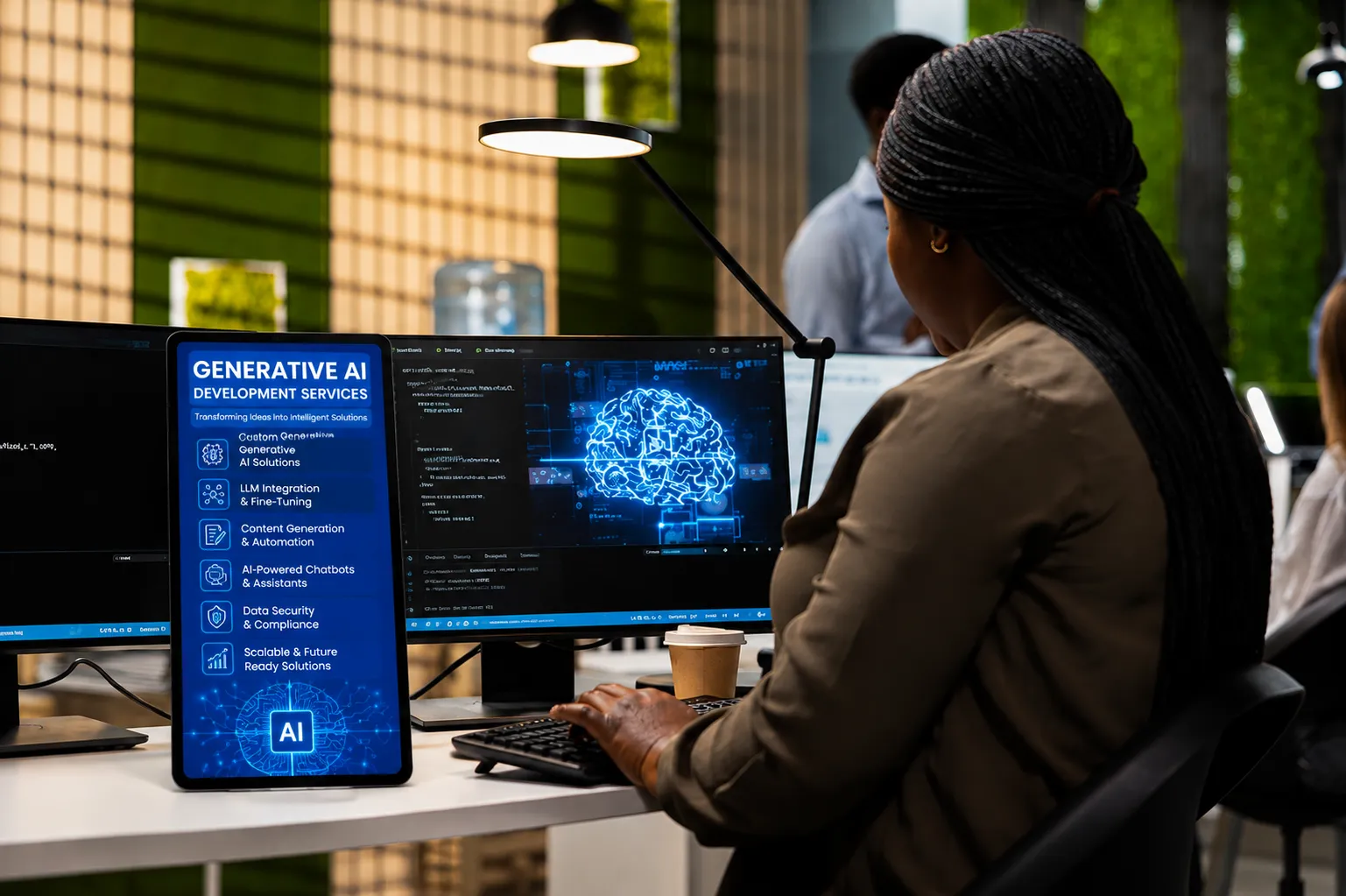
Generative AI is changing how businesses create content, interact with customers, process information, and automate everyday operations. Unlike traditional software that follows predefined rules, generative AI can understand instructions, analyze context, and produce new content such as text, summaries, code, images, and other outputs. Businesses looking to adopt this technology strategically can use Generative AI Development Services India to create customized solutions that align with their workflows, data, customers, and long-term growth objectives.
The real opportunity is not simply adding an AI chatbot to a business. It is about integrating generative intelligence into processes where it can save time, improve productivity, and create better experiences.
What Makes Generative AI Different?
Traditional automation typically follows fixed rules.
For example, a software system may receive an input, check predefined conditions, and produce a specific output.
Generative AI introduces a more flexible approach. It can interpret natural-language instructions, understand context, generate responses, summarize information, and assist with tasks that previously required significant human involvement.
This makes it useful for businesses dealing with large amounts of unstructured information and repetitive knowledge-based work.
1. Automating Repetitive Business Workflows
One of the biggest opportunities for generative AI is workflow automation.
Employees often spend hours writing emails, summarizing meetings, preparing reports, reviewing documents, creating descriptions, and processing internal information.
Generative AI can assist with many of these activities.
For example, an AI-powered workflow could receive a customer request, understand the issue, retrieve relevant information, prepare a response, and route complex cases to the appropriate employee.
This can reduce repetitive workload while allowing employees to focus on higher-value responsibilities.
2. Transforming Customer Support
Customer expectations are increasing, and businesses need to provide fast and useful support.
Generative AI can power conversational assistants that understand natural-language questions and provide context-aware responses.
Businesses can connect these systems with approved knowledge sources, product documentation, FAQs, and internal information.
Instead of forcing customers to navigate multiple pages, an AI assistant can help them find answers through a conversational experience.
Human agents can also use AI to summarize customer conversations, suggest responses, and retrieve relevant information.
3. Improving Content Creation
Creating business content can consume significant time.
Marketing teams, sales departments, HR teams, and customer support organizations regularly create emails, product descriptions, reports, social media content, summaries, and internal communications.
Generative AI can accelerate these activities by producing initial drafts and adapting content for different audiences.
Human review remains important, particularly for brand messaging, accuracy, compliance, and sensitive business information.
The strongest approach combines AI’s speed with human expertise.
4. Smarter Document Processing
Businesses generate and receive large numbers of documents every day.
Contracts, invoices, proposals, reports, applications, technical manuals, and policies can contain valuable information but require considerable effort to review.
Generative AI can help extract information, summarize documents, answer questions, classify content, and identify relevant sections.
When combined with retrieval systems and business databases, AI can make organizational knowledge easier to access.
This can be particularly valuable for businesses where employees regularly search through large document collections.
5. Personalized Customer Experiences
Customers increasingly expect businesses to understand their individual needs.
Generative AI can support personalized experiences by combining customer information, interaction history, preferences, and contextual data.
For example, an online retailer could provide conversational product recommendations, while a financial application could offer personalized explanations of account information.
Personalization can make digital experiences more relevant and help businesses strengthen customer relationships.
6. AI-Powered Software Development
Generative AI is also changing the way software is created.
Developers can use AI to assist with code generation, documentation, testing, debugging, code explanations, and technical research.
This does not eliminate the need for experienced developers. Instead, it can help development teams complete certain tasks faster and focus more attention on architecture, security, product requirements, and complex engineering challenges.
Organizations working with an AI development company can integrate these capabilities into broader development workflows while maintaining appropriate quality and security controls.
7. Building Intelligent AI Assistants
Generative AI enables businesses to build assistants specifically for their employees and customers.
An internal assistant could help employees search company policies, summarize documents, find information, or answer operational questions.
A customer-facing assistant could help users with products, services, troubleshooting, or account-related questions.
With appropriate integrations, these assistants can move beyond simple conversations and interact with business systems.
8. Creating AI Agents for Complex Tasks
The next stage of generative AI is moving from answering questions toward completing tasks.
AI agents can use language models together with APIs, databases, retrieval systems, and other tools.
For example, an agent could receive a business request, gather information, analyze it, perform approved actions, and provide a final result.
This can support workflows involving customer service, research, reporting, scheduling, sales operations, and internal automation.
However, businesses should implement permissions, validation, monitoring, and human oversight where necessary.
9. Supporting Better Business Decisions
Generative AI can make large amounts of business information easier to understand.
Executives and employees can interact with reports, documents, and datasets using natural-language questions.
AI can summarize trends, highlight relevant information, compare documents, and generate explanations.
This can reduce the time required to find information and support faster decision-making.
Generative AI should complement business judgment rather than replace human responsibility for important decisions.
10. Integrating Generative AI With Existing Systems
Enterprise AI rarely works as a standalone tool.
Businesses may need to connect AI with CRM systems, ERP platforms, websites, mobile applications, databases, cloud services, APIs, and internal knowledge bases.
A Software Development Company can help integrate generative AI into an existing technology environment.
This includes designing APIs, authentication, databases, cloud infrastructure, monitoring, security controls, and application interfaces around the AI system.
How Businesses Can Adopt Generative AI Successfully
Successful adoption requires more than choosing an AI model.
Businesses should begin with a specific problem and define measurable objectives.
Next, they should evaluate data quality, privacy requirements, integration needs, model capabilities, infrastructure, and expected costs.
Starting with a focused use case can help organizations validate the technology before expanding it across multiple departments.
Businesses should also establish guidelines for AI-generated content, data security, human review, monitoring, and responsible usage.
Why Choose Rushkar for Generative AI Development?
Rushkar helps businesses develop customized generative AI solutions designed around their specific operational and customer requirements.
Its capabilities include LLM development, AI agents, multimodal AI, AI-powered applications, enterprise workflow automation, conversational AI, and integration with business systems. Rushkar Generative AI Development Services
The focus is on moving beyond AI experimentation toward practical solutions that can be integrated into real business environments.
Rushkar can help organizations evaluate use cases, select suitable technologies, develop AI applications, integrate them with existing systems, and prepare solutions for future scalability.
The Future of Generative AI in Business
Generative AI will continue evolving from simple content-generation tools into intelligent systems capable of understanding business context and completing multi-step workflows.
The combination of LLMs, RAG, AI agents, automation, enterprise data, and multimodal capabilities can create new opportunities across industries.
Businesses that develop a clear AI strategy today can position themselves to take advantage of these capabilities as the technology matures.
Conclusion
Generative AI is transforming enterprise operations by helping businesses automate repetitive work, improve customer support, personalize experiences, process documents, assist developers, and make information more accessible.
However, successful implementation depends on choosing the right use cases, integrating AI with existing systems, protecting business data, and building solutions that can scale.
Ready to transform your business with generative AI? Partner with Rushkar to design and develop customized AI solutions built around your business goals. Contact Rushkar today to explore how generative AI can streamline your operations, improve productivity, strengthen customer experiences, and create new opportunities for sustainable business growth.
